
The announcement is days away — here’s everything you need to know about the favorites, the snubs, and what’s at stake.
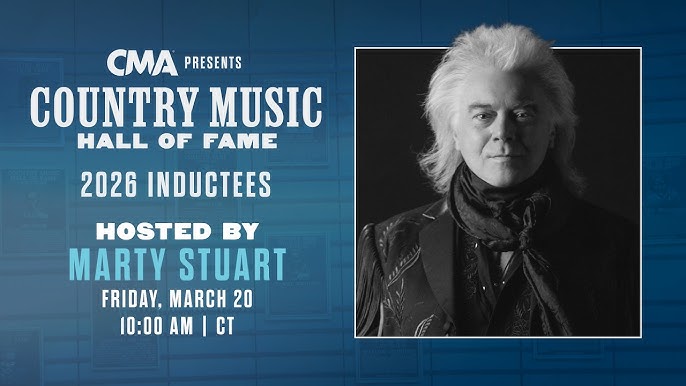
The country music world is about to find out who joins its most hallowed institution. Marty Stuart will host the official announcement of the 2026 Country Music Hall of Fame inductees on March 20, livestreamed from the Hall’s rotunda on the CMA’s YouTube channel at 10 a.m. CT. Country Standard Time: Three new members will be named, and the debates are already heating up.
How Does the Hall of Fame Selection Process Work?
Since 2010, inductees are selected across three categories: the Modern Era (eligible 20 years after achieving national prominence), the Veterans Era (eligible after 45 years), and a rotating Non-Performer/Songwriter/Musician category for artists active prior to 1980. A secret committee appointed by the CMA casts the final ballots. Whiskey Riff
With a musician selected in 2024 and a non-performer in 2025, the 2026 Songwriter/Non-Performer slot is expected to go to a songwriter. Whiskey Riff
Last year’s inductees were Kenny Chesney, June Carter Cash, and Tony Brown. Country Standard Time
Modern Era: The Big Names in Contention
The Modern Era race is wide open after Kenny Chesney’s 2025 induction, but a few names stand far above the rest.
Tim McGraw is widely considered the frontrunner. With 27 #1 hits over more than two decades — including iconic tracks like “Don’t Take The Girl” and “Live Like You Were Dying” — McGraw has built one of the most consistent careers in country history. Many insiders feel his induction is a matter of when, not if, and with Chesney now enshrined, 2026 could finally be McGraw’s year.
Dwight Yoakam remains the choice of traditionalists and hardcore fans. With 25 million records sold and an influence that still resonates across generations of artists, Yoakam’s omission is one of the Hall’s most debated gaps. His California roots may work against him with Nashville-centric voters, but his legacy is undeniable.
Alison Krauss has a resume that arguably speaks for itself. A 27-time Grammy winner and central figure in the O Brother, Where Art Thou? soundtrack, Krauss did more for bluegrass’s mainstream visibility than almost anyone in the modern era. A recent reunion tour and album with Union Station has kept her name top of mind.
Shania Twain, the best-selling female artist in country music history with over 100 million records sold, is another name that will inevitably make it in. Her Canadian roots and years spent living abroad may complicate her proximity to voters, but statistically, there is no bigger name still outside the Hall.
Clint Black is the sleeper pick many fans feel is long overdue. Thirteen #1 singles — including his first four consecutively — and 29 Top 10 hits made him one of the defining voices of 1990s country. His decision to step away from the industry in 2001 to focus on family may have cost him career momentum, but it shouldn’t cost him a Hall of Fame plaque.
Veterans Era: Long Overdue Legends
The Veterans Era backlog is, by many accounts, even more severe than the Modern Era. Decades of deserving artists are still waiting.
Vern Gosdin — known simply as “The Voice” among country music devotees — compiled 19 Top 10 hits and earned a reputation among peers as one of the greatest singers the genre has ever produced. There has been growing buzz that Gosdin is finally being seriously considered.
The Maddox Brothers & Rose helped establish the very foundations of California country and the Bakersfield Sound, and their flamboyant stage presence directly influenced artists from Elvis to the Nudie Suit tradition. Their prominence in Ken Burns’ country music documentary brought renewed attention to their legacy.
The Nitty Gritty Dirt Band, fresh off a farewell tour, bridged folk, rock, and country for over five decades. Their 1972 landmark album Will the Circle Be Unbroken brought legends like Roy Acuff, Earl Scruggs, and Mother Maybelle Carter to new audiences and remains one of country music’s most important recordings.
Johnny Paycheck, despite a complicated personal history, was a performer’s performer whose work with George Jones, Buck Owens, and others cemented his place in the genre’s backbone — well beyond his signature “Take This Job and Shove It.”
Songwriter Category: Who Deserves the Nod?
Rodney Crowell is widely viewed as the most likely pick this year. Five consecutive #1 singles as a performer, combined with a songwriting catalog that spans decades and genres, makes him a natural fit. Inducting him as a songwriter also preserves the Veterans Era slot for someone who has been waiting longer.
Paul Overstreet is another strong contender, having written “Forever and Ever, Amen” and “When You Say Nothing at All” — two of the most enduring songs in modern country.
For fans of the Outlaw tradition, Townes Van Zandt and Guy Clark remain the most passionate causes. Both wrote songs that were recorded by everyone from George Strait to Johnny Cash, and both are considered by many to be the greatest songwriters the genre ever produced — yet neither has been recognized by the Hall.
The Bottom Line
The 2026 class will be revealed Friday, March 20. Whether it’s McGraw stepping into the Modern Era, Gosdin finally getting his long-overdue recognition in the Veterans category, or Crowell earning a songwriter’s plaque, this year’s inductees are sure to spark the passionate debate that makes the Country Music Hall of Fame conversation one of country music’s great annual traditions.
Tune into the CMA’s YouTube channel at 10 a.m. CT on March 20 to watch the announcement live.